

Preventive maintenance relies on controlling two key variables that quietly influence component lifespan: lubricant condition and contamination levels. In heavy equipment, fluids serve more than just "keep things slippery.” They control friction, carry heat, enable hydraulic power transfer, and safeguard precision surfaces operating under high loads and tight clearances.
Filters serve as a supplementary control measure. They eliminate particles and water that would otherwise circulate through pumps, bearings, injectors, and valves. When fluid quality declines or filtration is overlooked, the failure process is rarely sudden at first; it usually begins with accelerated wear, heat stress, and reduced efficiency, eventually leading to downtime and major repairs.
Central Alberta operating conditions heighten the risks. Cold starts increase viscosity-related stress and delay full-flow lubrication, while dust and seasonal debris raise the chances of ingestion and contamination. Choosing suitable fluids, maintaining them at proper service intervals, and using filtration and analysis to verify condition are effective ways to prevent costly failures.
The Maintenance Principle: Control Viscosity, Heat, and Contamination
A fluid’s protective value depends on its viscosity at the temperatures and loads the machine actually encounters. Viscosity grades are set so oils satisfy low-temperature (“W”) and operating-temperature standards; the “W” part indicates cold-temperature performance, while the second number indicates viscosity at operating temperature.
Fluid condition varies over time. Diesel engine oils, for example, can thicken as soot and oxidation build up, or become thinner if fuel dilution occurs. Any change in viscosity can be harmful because it affects the oil film that separates moving parts.
Contamination control is the other half of the equation. In hydraulic systems, contamination is widely recognized as a major cause of failures, and cleanliness targets are typically set and monitored using ISO cleanliness coding methods.
Engine Oil: Pressurized Lubrication and Heat Management
In heavy-duty diesel engines, engine oil lubricates internal components and, in vital areas, must be delivered under pressure by an oil pump to protect bearings and other high-load surfaces.
Engine oil also acts as a heat absorber in many designs. It can be routed through an oil cooler to dissipate the heat it absorbs, aiding in thermal management under sustained load.
Oil performance standards and why they matter
Heavy-duty diesel engine oils are classified according to performance specifications that address wear control, oxidation resistance, soot management, aeration control, and compatibility with modern emissions systems.
Cold weather viscosity selection (practical implications)
Cold-start lubrication depends on how quickly oil can flow and how quickly it can build pressure. Full-synthetic heavy-duty oils formulated for severe cold can be used across a wide range of ambient temperatures, including those typical of Central Alberta winters.
For some diesel engine applications where extremely low start-up temperatures require a 0W-grade oil, preferences for better protection at higher temperatures within that category have been documented (for example, choosing 0W-40 instead of thinner 0W grades in certain cases).
What degrades oil in real service
Oil degradation is usually caused by oxidation (heat exposure), soot buildup, shear, and fuel dilution, each of which impacts viscosity and film strength.
The role of the oil filter
The oil filter is a key control point for removing circulating particles before they can wear down internal surfaces. Since oil condition and contamination are connected, filter changes are an essential parts of maintaining a stable lubrication environment, not just optional extras during oil changes.
Used Oil Analysis: Verification Instead of Assumption
A preventive program becomes more dependable when it gauges fluid condition rather than assuming it. Fluid analysis programs routinely assess viscosity, contamination, particle count, and elemental content (wear metals) to support equipment management decisions and control costs.
In structured programs, metal wear indicators can signal abnormal component deterioration, and contamination markers can suggest issues like compromised air filtration or coolant ingress.
Sampling intervals should meet engine and duty-cycle requirements. In one published guidance example for heavy-duty diesel applications, oil sampling at regular hourly intervals and repeated trend monitoring across multiple drain cycles is recommended to establish consistent behavior.
Coolant: Heat Transfer, Freeze Protection, and Additive Control
The primary coolant system transfers heat from the engine to the outside air using engine coolant, a radiator, and controlled airflow. Coolant is circulated through the engine by a water pump, absorbs radiant heat, and then dissipates it through the radiator. Over time, coolant can lose effectiveness due to heat exposure, which is why replacement according to the manufacturer’s schedule is necessary.
Heavy-duty coolant chemistry is also standardized in industry specifications that set performance standards and manage additives. One heavy-duty coolant specification describes fully formulated glycol-based coolants and notes that supplemental additives are usually not necessary until the first maintenance interval, after which maintenance dosing may be needed in certain heavy-duty designs.
Practical preventive maintenance for the coolant system should include verifying coolant concentration and freeze protection, monitoring inhibitor condition as needed, and inspecting hoses, clamps, and leak points, since coolant loss can quickly lead to overheating.
Transmission Fluid and Gear Oil: Power Transfer and Thermal Stability
Transmissions rely on lubricant condition for durability and shift performance. Generally, heavy-duty maintenance references define transmission fluid as used in automatic transmissions, while gear oil is used in manual transmissions and differentials.
Transmission systems may also include dedicated cooling, in which heat absorbed by the fluid is released through a cooler, using a radiator-like heat transfer process.
For automatic transmissions used in vocational and off-highway applications, manufacturers highlight that choosing the right fluid and filter is one of the simplest and most effective actions an owner can take to support reliability and performance, with extensive testing programs verifying fluid quality.
Preventive practice should therefore focus on using approved fluid specifications, maintaining the proper fluid level, and replacing filters on schedule to ensure flow and pressure control.
Differentials and Final Drives: High-Pressure Lubrication Requirements
Differentials use gear sets to distribute power and allow wheel-speed differences during turns; their gears need to be properly lubricated.
In high-load hypoid gear environments common in commercial drivetrains, gear lubricant performance standards exist for severe operating conditions, including high-speed shock loading and low-speed, high-torque operation.
From a preventive maintenance standpoint, this underscores a clear operational rule: treat differential oil and final-drive lubricant changes as condition-critical, especially when equipment operates in water, heavy dust, or high heat, because contamination and oxidation directly diminish the lubricant’s ability to protect gear-tooth surfaces.
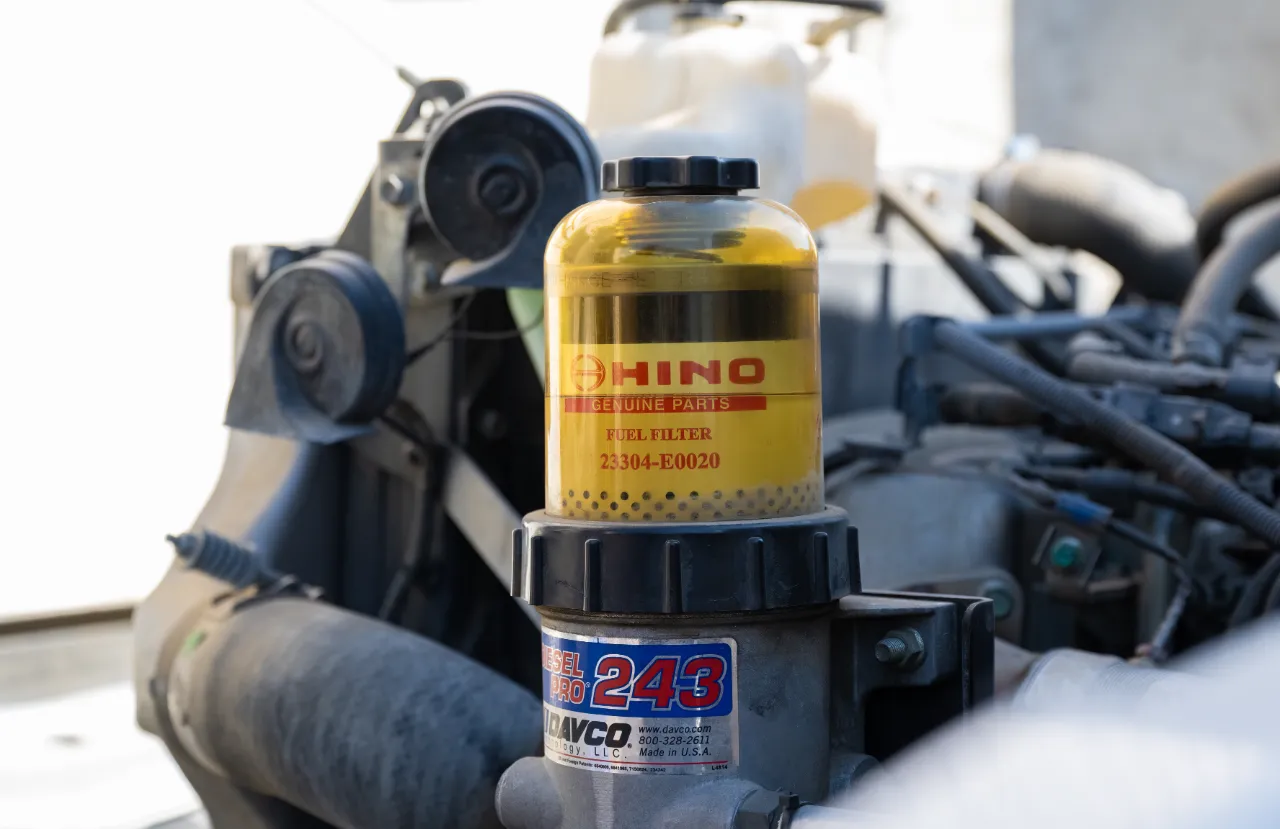
Fuel Filtration: Precision Systems and Water Control
Modern diesel engines have fuel systems that must handle contamination risks from dirt, rust, and water. Fuel filtration guidance for heavy-duty applications states that contaminants can cause serious damage, making filter quality and maintenance a reliability concern rather than just a consumable choice.
Water contamination poses a particular risk to high-pressure common rail systems, which are more vulnerable to water and water emulsions; water can lead to filter clogging, deposits, and component damage.
A preventive maintenance routine should therefore include: scheduled fuel filter replacement; routine draining or servicing of water-separation devices, where equipped; and attention to fuel storage and handling practices that minimize water ingress.
Hydraulic Fluid and Hydraulic Filters: Cleanliness as a Reliability Target
Hydraulic systems pose a high risk because they involve tight clearances and constant circulation. Contamination-control references identify contamination as a leading cause of hydraulic-system failures and stress the importance of cleanliness monitoring and proper filtration practices.
ISO cleanliness coding is commonly used to classify and track hydraulic fluid cleanliness, with representative particle channels often linked to wear and damage in hydraulic systems.
From a preventive maintenance perspective, this supports three formal controls:
- Set a cleanliness goal suitable for the most contamination-sensitive parts of the system.
- Maintain filtration hardware, including proper filter ratings and timely replacements, so the system can effectively meet the target.
- Verify by measurements (particle counting and condition monitoring), since cleanliness cannot be confirmed visually.
Air Filtration: Preventing Ingestion-Based Wear
Diesel engines rely on clean intake air to protect internal parts and precise subsystems. In descriptions of heavy-duty engines, the air filter is clearly identified as the part that blocks debris and impurities from entering the engine.
Air filtration technical references highlight that effective filtration should be considered an integral system requirement for long engine life, and that damaged filters or improper service practices can allow contaminant entry, accelerating wear.
In Central Alberta environments where dust and debris loads can be significant, preventive practices should include inspecting the entire intake tract (housing seals, clamps, boots, and restriction indicators, where present), as an intact filter element alone does not guarantee system integrity.
A Formal Preventive Maintenance Framework for Fluids and Filters
Preventive maintenance is a planned approach to inspecting, servicing, and maintaining parts to prevent breakdowns and prolong operational lifespan, unlike reactive maintenance performed after failure.
A practical framework for managing heavy equipment fluids and filters can be applied in four layers.
1) Specification control
Use fluids that meet the machine’s required performance category and viscosity grade for anticipated ambient temperatures and duty cycle.
2) Interval control
Set service intervals according to manufacturer recommendations and adjust only with documented evidence (e.g., analysis trends, duty severity, operating hours, and contamination exposure).
3) Filtration control
Replace filters as scheduled and verify that the filtration hardware meets the system’s cleanliness and flow standards.
4) Verification control (analysis and inspection)
Use oil and fluid analysis to monitor viscosity changes, contamination, and wear metals; perform coolant and fuel checks to identify early system issues before they cause failures.
Common Preventable Failures Linked to Fluids and Filters
Several common “unexpected” failures often originate from control failures in fluid condition or filtration.
- Loss of lubrication protection caused by viscosity changes from soot, oxidation, or fuel dilution.
- The risk of overheating increases when coolant effectiveness declines or when coolant is lost, reducing heat transfer capacity.
- Hydraulic component wear and malfunction are linked to particle contamination and failure to meet cleanliness targets.
- Water contamination in diesel fuel increases the risk of fuel system damage, especially in high-pressure systems.
- Accelerated engine wear occurs when intake filtration is compromised by damaged or improperly serviced filters.
Conclusion
A formal preventive maintenance program for heavy equipment fluids and filters is essentially about managing risks. Engine oil must keep its viscosity and cleanliness to protect pressurized lubrication surfaces and control heat. Coolant must maintain heat-transfer ability and additive protection. Transmission fluid, gear oil, and differential oil need to stay stable under high load and thermal stress. Hydraulic fluid must meet cleanliness standards that protect tight-tolerance parts. Fuel filtration and water control are essential to prevent damage to precision fuel systems. Air filtration must avoid ingestion-based wear.
For Central Alberta operations, these controls are especially important because cold starts and exposure to contamination raise the likelihood and severity of fluid-related failures.
For a fleet-appropriate fluid, filtration, and analysis schedule aligned with your operating hours and duty severity, contact Black Sheep Heavy Duty to establish a documented preventive maintenance program that focuses on uptime and component longevity.